Move Intentionally and Heal Things:
A Philanthropic Manifesta for What the World Needs Now
BY BETH GALLAGHER, PRINCIPAL AND FOUNDER, EMERGENT PHILANTHROPY | JULY 31, 2026

Author's Note:
I’ve been reading and hearing a great deal lately about the new waves of wealth forming in the United States. Much of the conversation comes from commercial players — banks, consultancies, fintechs — and fundraisers understandably interested in reaching these emerging market segments. Others are imagining what might become possible if tech-informed philanthropy can swoop in and solve long-standing social challenges with new and novel solutions.
But I keep finding myself wanting the conversation to go deeper. Beneath the excitement are larger questions about how wealth is generated, how it moves, who benefits, who is left behind, and what kind of awareness is needed when resources of this magnitude move into new hands.
This feels like a time that calls for more courageous conversation. This piece is my contribution. I bring a healthy dose of both concern and optimism to offer my thoughts on what this moment is asking of us.
Prefer to read or share the formatted version? Download the PDF
“The current polycrisis and wave of systemic breakdowns cannot be solved by the same thinking that created them.”
— OTTO SCHARMER, “PHILANTHROPY 4.0”
There is much buzz and an incredible amount of speculation right now related to two massive wealth events taking place simultaneously. Both of these events have broad implications across sectors including wealth management, philanthropy, and for- and nonprofit social enterprises.
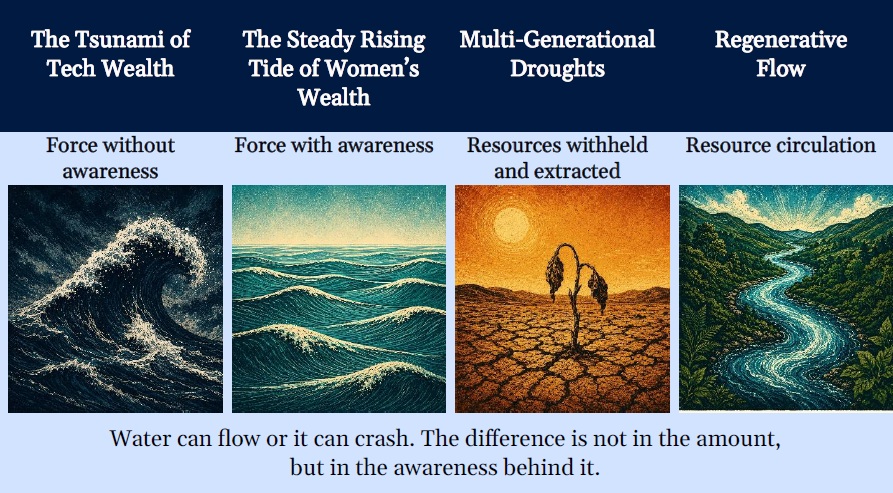
The first is being described as a tsunami, and rightly so, given the scale, speed, and force with which new wealth will be unleashed through several new tech IPOs planned this year, including SpaceX, the largest in American history.1,2 The numbers are truly astonishing. According to estimates, “The public listings of OpenAI, SpaceX and Anthropic could mint more than 16,000 millionaires,” with an expected liquidity transfer totaling roughly $2-$3.7 trillion in individual equity value.3 The second, slower moving yet more powerful wave, is that of the great wealth transfer that is contributing to the rise of female wealth holders. This macro-economic shift will see approximately $35 trillion transition into the hands of women over the coming years, complementing the capital that women are increasingly generating on their own through entrepreneurial ventures, corporate leadership, and equitable partnerships. While women “currently control about one-third of all retail financial assets in the European Union and United States, this share is expected to rise to 40 to 45 percent by 2030.”4 These trendlines suggest that women could control a majority of wealth in the not-too-distant future.
Anticipation and excitement are warranted in both cases. What becomes possible when this much financial capital moves into new hands? What kind of new world might be created together? What problems will be solved? What new companies or ventures might launch? Who might benefit? Who gets left behind?
Having witnessed the ebbs and flows of many philanthropic movements during my career, I consider myself a pragmatic Pollyanna. And I’ve got some thoughts, folks! This piece considers the undercurrents of these wealth events, including what quality of awareness is needed to ensure resources circulate in ways that are more likely to benefit the many, not just the few.
MOVING RESOURCES WITH AWARENESS
Tech IPOs, Tech Bros, and the Coming Tsunami
My first question regarding the tech-wealth tsunami is whether we can count on a corresponding wave of generosity. The behavior of our current generation of tech billionaires and millionaires has shown a preference for accumulation over circulation and a series of esoteric, individual interests over the greater good.5
My next question is how can we possibly trust the very architects of a number of our current crises to fix them? That would require a profound level of cognitive dissonance. It’s helpful to begin by looking at the investment logic underpinning it all. Catherine Bracy’s book World Eaters6 lays out in a clear and compelling way the very manner through which this concentration of wealth has been generated in the first place: venture capital. Venture capitalists are interested primarily in investing in ventures that can scale, and quickly. This usually includes practices like cutting regulatory corners, using predatory pricing, exploiting and reclassifying workers (e.g. relying heavily on contractors and gig workers), and some downright dubious customer-acquisition practices. Companies either scale rapidly, at an unnatural pace, or get shut down, even if they might be considered worthy and valuable by more patient investors.
To achieve outsized returns in these bold ventures, the venture model willfully ignores the individual and societal cost to humans’ livelihoods, the environment, healthcare access, affordability, our social fabric, and community resilience. I could go on…
And what comes after their disruptions? Investors and fund managers pocket the proceeds while the risks and ramifications of how they operate are borne by others. Public programs, philanthropy, and individual communities are left to address the downstream effects, having to fund and provide care, even as the disruptions caused by those upstream persist.
Another glaring deficiency in these ventures is who isn’t at the table. Who is considered worthy of investment? Whose genius is celebrated? Whose ideas are valued? Which disciplines and modalities spark interest? Whose visions get realized—and whose don’t? The data tell an abysmal story here both in terms of who receives funding and how much they receive:
In 2022, Black and Latino founders received only 1% and 1.5% respectively of total US venture capital (VC) funding. Women-founded teams received 1.9% of VC funds, and only 0.1% of VC funds went to Black and Latina women founders.
It’s a gap that persists through each stage of growth. Looking at the total funding received (across stages) for the highest-funded startups at the time of exit reveals that the average startup of a White male founder received over $210 million in total funding, while the average startup of an underrepresented founder received a mere 43% of that—$91.1 million.7
Myriad innovations are being left behind as a result. What concerns me is that those who have made commitments to share wealth that was generated through the technology sector and venture capital tend to bring those same mindsets, preferences, and frameworks to their philanthropic initiatives (e.g. unnatural scaling, failure to account for all costs, and empirically exclusionary practices).
When the right tool and right talent is brought to bear in solving problems, incredible things become possible. What becomes problematic is when financial wealth is treated as a proxy for genius and when models like venture philanthropy are championed as singular solutions. The same problematic dynamics around funding flows simply translate to a new context—including who receives funding and who doesn’t. Studies indicate that only a single‑digit share of total charitable dollars is directed to communities of color; roughly only 4% of grants and contributions in 2022 went to organizations led by BIPOC leaders; and there are notable and consistent gaps in access to unrestricted funding and foundation grants.8,9
Further, when venture philanthropy strategies are applied to fields that do not behave like markets, namely when attempting to “fix” entrenched social challenges like systemic inequities in education, workforce, healthcare, housing, or food security, these efforts tend to bump up against the limitations of a venture approach and tech mindset, which can result in more harm than good.
As the first tech billionaire, Bill Gates was also the first to engage in mega philanthropy. Big strategies, big money, and big swings. I give him credit for wanting to bring his formidable wealth to bear in solving problems and improving people’s lives globally, for championing accessible green energy and for launching the Giving Pledge to encourage other wealth holders to be more philanthropic. But because he brought his Microsoft mindset to the foundation’s strategies, the results have been mixed.
The Gates Foundation’s efforts in global health are laudable. These include their work in immunization and disease eradication, which have saved tens of millions of lives. Medical interventions like polio vaccinations address a direct causal chain. Shots are distributed and administered, exposure to the disease is reduced, and the specific health outcome can be tracked (e.g. fewer cases of polio). Tackling an issue area like K-12 education becomes much messier, because learning is simultaneously shaped by a variety of factors, including family income, housing, nutrition, school leadership, neighborhood conditions, race, disability, and policy context. That means that a high-control, metrics-heavy model like that which the Gates Foundation tends to favor might ignore or miss inherent, systemic drivers of inequity, even if the model looks rigorous on paper.
We can thank Gates for helping to expose how hard it is to engineer educational improvement. We can’t apply a “vaccine” mindset to educational inequity (e.g. administer the right curriculum model or teacher evaluation tool at scale) and expect similar results. What has become clear is that his foundation overestimated how much data-driven managerial reform can do when it comes to public education systems that are deeply unequal and very complex.
Similarly, Mark Zuckerberg famously flubbed his $100 million Newark public schools initiative.10 It serves as a case study of a top-down, business-style strategy bumping up against the complexity of entrenched inequity resulting from decades of disinvestment. Zuckerberg’s initiative enlisted “experts,” but many were not from the area, and too few students, teachers, and principals were invited to guide the work.
And let’s just say in philanthropy, the accountability and risk tend to flow one way, downstream, to the organizations doing the hard work. They flow down to the communities most impacted by upstream preferences around policies, programming, and desire for scale, etc. Meanwhile, funders upstream can pivot on a whim, to derisk themselves, curry political favor, avoid political blowback - or sometimes simply to chase the next interesting cause or promising theory of change - with few, if any, negative consequences for their exits.
How about in philanthropy, we don’t “Move fast and break things.”
Bringing that mindset to philanthropy can be really damaging. In the social sector, especially in spaces where inequitable systems persist for a multitude of reasons (namely because those who benefit from the status quo don’t want them to change!), what gets broken is community trust, what gets disrupted are livelihoods and already fragile support structures. What doesn’t get disrupted are the cycles of systemic inequity and harm that have led to a continued concentration and accumulation of wealth, in spite of all the charitable pledges, statements, and theories of change. In the meantime, inequity becomes more entrenched, and the funders’ personal fortunes allow them to eliminate barriers that would prevent them from continuing to grow their own wealth.
Notably, Jeff Bezos does not meaningfully engage in philanthropy. Estimates suggest that he’s given just 1.7% of his wealth to nonprofits, notably less than the 2% average for household giving in the US. Bezos recently stated in an interview that he believes “If I do my job right, the value to society and civilization from my for-profit companies will be much, much larger than the good that I do with my charitable giving.”11 That is quite a logical sidestep when you consider the harm his companies do: the negative costs of poor labor practices, anticompetitive market consolidation, and environmental impact.
Elon Musk, the world’s first trillionaire, seems to be the least generous of all. His ethos of tech-bro disruption and exit logic at extreme scale was on full display during his stint leading the Department of Government Efficiency (DOGE). DOGE’s decision making took place in a black box, leveraging aggressive headcount reductions that relied heavily on arbitrary data algorithms. DOGE bros drove massive layoffs, dismantled USAID, and gutted programs and contracts deemed unnecessary or DEI-related. Reporting suggests that Black women were among the hardest hit by those federal layoffs.12 USAID cuts led not only to the loss of life from preventable infectious diseases, but a recent study also shows that incidents of conflict rose quickly in regions of Africa following these abrupt, unplanned pullbacks.13,14 They achieved their “disruption” for sure. But the savings to the overall federal budget were so minimal as to be immaterial while the human cost of these employment and funding cliffs is immeasurable.
With their private rockets and plan to colonize Mars, their desire to create virtual and alternate realities, their investments in building literal moats and apocalyptic bunkers, and biohacking to avoid the natural course of aging, all these men seem far more interested in escaping reality and the consequences of their actions than they are in investing in a better world.
These tech entrepreneurs appear to be only interested in creating conditions in which their businesses will thrive and they will continue to enrich themselves. Businesses that rely on operations that harm people and the environment are not truly innovative; they are exploitative. This is ego-system thinking writ large, wherein self-interest, maximized individual gains, and externalized costs willfully neglect any sense of interdependence with, and responsibility to, the whole. For the rest of us, the stakes are enormous.
Now, with the ramping up of artificial intelligence (AI) and promises of optimization coming from these very same people, these agents of chaos, I feel like I have heard this song before.
So, even as I feel excited about the positive applications around tech for good—advances in healthcare efficacy, risk forecasting and mitigation, adaptive learning platforms, and much more—I am concerned about where data centers are going, what jobs will be available on the other side, how nefarious actors could weaponize these tools, and how we maintain respect for what’s truly human in an increasingly digital world. It would be naïve not to expect more disruption and more wealth inequity to come from AI. It would be difficult to trust and believe that these tech CEOs hold better human outcomes and a healthier planet as guiding principles.
As James Baldwin declared, “I can’t believe what you say…because I see what you do.”15 I am deeply skeptical about how this tsunami of Silicon Valley wealth will land and what will be left in its wake. I don’t intend to debate here whether billionaires and trillionaires should exist. My primary concern is that the wealth generated by this class is likely to be used in ways that replicate the mindsets and behaviors that generated it.
Will it go into VC funds and investments that continue the selfsame cycle? Will any of it move into charitable efforts or vehicles? If so, will it end up sitting in foundations and donor-advised funds, with an underwhelming and insufficient trickle making its way to communities in need? Will this next wave of wealth holders bring the same harmful hubris that drove the cautionary tales above?
Or can we dare to hope for something radically different and truly transformative?
I want to offer a counter-mantra. How about we,
“Move intentionally and heal things.”
Which brings us to the other, far more interesting wave that is already underway and holds a great deal of promise and possibility: women and wealth.
The Feminine Foil: A Steady, Rising Tide
As I noted at the outset, women are continuing to gain greater shares of overall financial wealth at a macroeconomic scale through greater earnings, more female entrepreneurs, and the great intergenerational wealth transfer underway. This has powerful implications across sectors. And we can look at what’s already happening to get a sense of what’s to come as women continue to gain economic power and financial influence. 16
Women tend to manage their financial resources with a distinct, community-first approach. Globally, women prioritize family welfare, community resilience, and social impact across their spending, saving, and sharing habits.
These are not “soft” practices. Studies show that women apply a more disciplined approach to their finances. They are informed, risk-aware, and more goal-oriented and values-aligned. They take a long-term view. They stay the course during volatility. And they get results. Research has shown that women’s portfolios outperform men’s over time.17 These are not strategies that enrich one overnight. Rather, they are strategies that consistently yield better returns for those who adopt them and also for others. This is what truly patient capital looks like.
In a recent survey of wealth holders, 80% of women cite “‘ethics, trust and social order,’ as core personal values, focusing on fairness and moral responsibility… most women believe that wealth comes with responsibility.”18 This internal philosophy directly informs how women circulate resources, which is driving a massive surge in values-aligned investing. The emergence of organizations like Invest for Better support these efforts by helping women come together “to learn, invest, and create change—together.”19
And women bring these very same strategies, mindsets, and investment behaviors to their philanthropy. In fact, women are increasingly taking a more holistic view of their resources, blurring the lines between traditional investment and philanthropic giving altogether. We see this in the giving of prominent women philanthropists.
In stepping away from the Gates Foundation, Melinda French Gates has very deliberately charted her own path, through Pivotal Ventures. In recognizing that gender equity is a proven, fundamental leverage point for addressing a multitude of other global challenges, her giving is more feminist, more trust-based, and more responsive to women and girls globally.
MacKenzie Scott is rightfully being celebrated for pioneering a “Wings with No Strings” approach. Yield Giving has brought billions of dollars to thousands of organizations. She’s giving with minimum restrictions and betting on the judgement of those already doing the work without needing to center herself in the process. She has shown us that scale and trust are not mutually exclusive.
Laurene Powell Jobs’s Emerson Collective breaks down the silos of traditional charity by deploying her full capital stack—combining grantmaking, political advocacy, and impact investing—to drive systemic change in entrenched areas like education reform, violence reduction, and environmental justice. She states, “None of the issues we are trying to address have easy solutions and making progress on them requires hard work, humility, rigorous thinking and a variety of approaches.”20 Amen to that!
Inspired by the work of Paul Farmer and Partners in Health, Charlotte Wagner evolved programs at the Wagner Foundation from a more traditional approach and purely local focus to employing accompaniment practices that include more holistic, systems-level investments in people and places. By providing multi-year, unrestricted, general operating support, she prioritizes the long-term resilience of local ecosystems across health equity, economic wellbeing, and the arts.
I want to pause here and note a common thread among this group of givers. Each of these four women are accomplished in their own right, having led impressive careers in the technology and financial sectors. Also notable is the fact that the extreme wealth fueling their philanthropy was generated largely by their husbands, through the very kind of founder roles that women are largely excluded from and using many of the problematic practices noted above. I suspect that these women’s years working in male-dominated spaces, no doubt feeling the pangs of marginalization that so many of us do in such workplaces, inform how they approach their philanthropy. Even from the exceptionally privileged positions they now occupy among the world’s 1% of wealth holders, it would seem that those early experiences drive their current commitments to advancing gender equity and social justice.
These women are reshaping philanthropy in ways that are already happening.
In bringing resources to where they are badly needed, these waves of transferred wealth through philanthropy have the power to deliver a rising-tide effect. And as very visible philanthropists, their community-centered approaches to giving are rippling across the sector and inspiring others to change their own giving practices.
Because of women’s growing wealth and influence, there is a great deal of speculation about what these trends mean for the wealth-servicing industry and for fundraising and philanthropy.21 While these insights are valuable, and there is a lot to feel encouraged by, I want to push things a bit further by disaggregating the data. What has been largely absent from discussions are the communities who do not benefit equally from these wealth-generation and wealth-transfer equations, due to systems that enrich some while others are shut out. Let’s pull these missing metrics back into the conversation.
Missing Metrics: Multi-Generational Droughts
Even as rates of household wealth have grown across all racial and ethnic groups in recent years, our extreme wealth concentration in the US continues not only to maintain but to deepen the racial wealth gap.22 While women’s earnings have been improving over time, the gains have been unevenly distributed across race and ethnicity. White women have benefitted the most from this growth.23 As far as women entrepreneurs go, we can celebrate the fact that women are launching an historically large share of new businesses, while also acknowledging the fact that access to capital varies greatly across racial lines.
Regarding the intergenerational wealth transfer, Urban Institute research states that, “White baby boomers hold more than 90% of all net worth that baby boomers hold… Meanwhile, Black and Hispanic baby boomers own less than 2 percent of the boomer generation’s net worth… This is not just a transfer of wealth—it will be a transfer of inequality.”24
The inequities don’t stop there, of course. Rural and Rust Belt communities across the Midwest and South have been starved of resources for decades. We see the evidence in population exodus, shuttered factories, degrading water systems, underfunded schools, and healthcare facilities that struggle to stay open. Our farming and food systems add to this fragility through industrial, consolidated production methods that employ concerning labor practices, have an adverse impact on the environment, and can be prone to food-borne illness and disease outbreaks. Sick systems create sickness. These outcomes are the result of policy choices and investment patterns that treat some populations and places as expendable while wealth and power accumulate elsewhere.
What Our Fracturing Systems are Telling Us
The deepening economic, health, and political divides in the US are manifestations of ego-system thinking, and the old structures are buckling under its weight. Our public systems and infrastructure are crumbling under the burden of debt, misaligned priorities, and an ineffective political ruling class populated by too many leaders who cling to power well past a reasonable retirement age. Their behavior reflects deep cynicism and brazen self-interest.
In the book Presencing, Otto Scharmer and Katrin Kaufer very astutely describe our current state as a polycrisis, not merely a series of unrelated emergencies, but the surfacing of three related core divides that ail us. They are evidence of our fracturing systems and the downstream costs:
- The ecological divide: a disconnect between Self and Nature that manifests in climate destabilization and massive biodiversity loss
- The social divide: a disconnect between Self and Other that manifests in inequality, hyperpolarization, violence, and war
- The spiritual divide: a disconnect between self and Self, between who I am now and who I could be. This divide manifests as a pandemic of mental health issues including anxiety, hopelessness, loneliness, and depression25
These fractures tell us that the issues outside are a mirror of our issues inside.
I often reflect on how this became clear during COVID—the sheer loss of life; the stress and challenge of trying to understand something so new to our lived experience; the systemic inequities brought starkly to light; the isolation; the daily disruption and damage to our individual and collective senses of control, safety, and normalcy—and how that personal and societal dysregulation persists all these years later. Now, with the pace of change brought about by technological advancements and those very systems and their algorithms contributing to misinformation and anxiety, it’s a lot, to say the least!
We are clearly in a period of ruptures and systems collapse. Amid all this change, I am deeply concerned with how we can limit the very real harm being done to people and the planet.
What does it look like to move intentionally and heal things? What more humane future is possible if we shift resources from systems of extraction to systems that are regenerative, systems where human and environmental impact metrics aren’t neglected, but take primacy? How do we address the downstream effects of the ego-system and tend to what needs to emerge? Through intention. By letting go of practices and mindsets that no longer serve us and by practicing self- and ecosystem awareness.
What the World Needs Now: Systems of Awareness
We are all being crushed under the weight of inequitable, unsustainable systems and care structures that are insufficient. It is going to take a radical redesign of how resources flow to create a world of nourishing and flourishing.
Charitable giving in the US consistently hovers at just 2% of GDP and 2% of household disposable income. So, even as I advocate for more effective philanthropy, I need to acknowledge the inherent limitations of donor-defined and -directed charitable giving that operates within a system that willfully separates how wealth is made and shared.
Furthermore, institutional philanthropy perpetuates its own accumulation tendencies. In the US, foundation endowments hold more than $1.5 trillion in assets while donor-advised funds have become the largest recipients of charitable dollars in the US, with assets now totaling more than $225 billion.26 Imagine what’s possible if we stopped warehousing philanthropic capital and let those resources flow more freely.
We don’t have to look far to find philanthropic models that circulate rather than consolidate. There are several approaches that are far more direct, more relational, don’t require high overhead, are community-governed and move resources with an appropriate sense of urgency to where they are needed. I’ll name here just a few ancient practices of care that have recently gained recognition and momentum, beginning with collective giving and mutual aid.
From community micro-granting and family and neighborhood giving circles to faith and identity groups, there are now nearly 4,000 collective-giving networks in the US alone, pooling more than $3 billion.27 These groups are led overwhelmingly by women and people of color.
Less formally, we see mutual aid on vivid display during responses to disasters, such as during COVID and more recently to mitigate the harm brought on by immigration enforcement deployments in cities like Chicago and Minneapolis. People continue to overcome the mistrust and divisiveness that feel so prevalent right now and show up in ways that matter: to take care of their neighbors who need food, childcare, transportation, and more. These formal and informal efforts, by their very nature, democratize giving and have shifted the narrative around who is considered a “philanthropist.” They also tend to direct resources into more community-based settings, expanding who and what gets funded.
Now, let’s pivot from models of giving to consider resource generation. Traditional investment models like VC are designed to siphon value away from labor, natural ecosystems, and local communities toward absentee shareholders, consolidating capital for a few while others experience drought. But there are a whole host of alternative models that effectively spur wealth generation and keep it circulating within the communities that produce it. These enterprises operate with both self- and ecosystem awareness in how they source capital, structure ownership, generate revenue, relate to communities, and measure success.
Cooperative Home Care Associates (CHCA),28 founded by Adria Powell in the Bronx, New York, is the largest worker-owned co-op in the US, with some $57 million in revenue in 2021. CHCA operates on a “Quality Jobs/Quality Care” philosophy, recognizing that high-quality, stable, and dignified employment is foundational to providing effective healthcare services. CHCA allocates an incredible 96% of its revenue directly to covering payroll and related expenses for its frontline care workers, a traditionally undervalued and underpaid workforce. In addition, they engage in advocacy work in the service of fair pay for all home care workers across the US, contributing to the betterment of the ecosystem of care at large.29
Red Bay Coffee has transformed its coffee supply chain into an inclusive value stream that elevates growing standards, pays farmers fairly, and provides employment access.30 BlocPower turns building decarbonization into a vehicle for lower energy costs, healthier housing, green jobs, and community-owned infrastructure.31 East Bay Permanent Real Estate Cooperative removes land from private speculation and places it into long-term community stewardship structures.32 Native Renewables advances solar energy access, local workforce capacity, and Indigenous energy independence in communities long harmed by extractive energy systems.33 Opportunity Threads is a worker-owned textile factory that uses upcycling and sustainable production practices.34 Jubilee Justice integrates restorative capital with sustainable farming practices through regenerative agriculture.35
In my view, these examples are what true genius and meaningfully disruptive innovation looks like. Enterprises that factor in all the costs and bring value to our world. If more businesses operated like these, we wouldn’t need to rely so heavily on public programs or philanthropy because the care would be built in. Harm is mitigated before it even has a chance to flow downstream.
In a world quite literally on fire, the question is: What is the role of philanthropy right now?
Do we address the urgent downstream harm and symptoms of collapse? Or invest in the enterprises—for profit, nonprofit, and the ones that blur the lines—that operate in ways that are more self- and ecosystem aware? Or should we fund the connective tissue that lets a whole field of these enterprises emerge: the intermediaries, the networks, the capacity, the policy advocacy, the shared infrastructure that helps a model become a movement?
Yes, yes, and yes.
It’s up to each of us to be clear about what is ours to do in this moment in order to move from inertia to action. As a philanthropic advisor, I have the privilege of guiding clients through a process that unlocks that very clarity and supports informed decision making.
Finding Our Flow
In my work with families and organizations, I’m motivated by the simple premise that most people want to be more generous—and many would be more generous if two things were true: they felt more confident in their approach and their giving felt more meaningful in their lives. That’s why before we even begin talking about money, other assets, charitable vehicles, or philanthropic and responsible investment models, we start with a deeper set of questions that get underneath the surface. We explore and articulate what they value and why; we uncover and identify what’s motivating their desire to engage in this work; and we develop a vision of the change they hope to make in the world.
Then we look at the causes and communities that inspire them and conduct landscape scans that offer a functional understanding of the challenges, dynamics, stakeholders, and potential areas for investment. We learn the landscape before we try to change it.
With those essential insights in hand, we can really begin making informed decisions around dimensions such as:
- Their appetite for risk
- Who will participate, join them
- What timeline they envision
- Whether they want to meet immediate needs or invest in addressing root causes
- Whether they will engage in pure philanthropy or something along the scale of impact investing
- What kind of relationship they want to have with the people and places they hope to support
- Who will define what success looks like
- Whether they will operate solo or partner and collaborate with others
- Whether they want to have a public presence or move quietly under the radar
And finally, we consider what forms of capital they wish to bring to bear and what levers for change they want to pursue. The process is designed to allow them to hold complexity and bring an informed awareness of implications and potential downsides to their decision making.
Before acting on the plan, we pressure-test it by listening to community-informed perspectives and mapping the system, distinguishing key actors, locating barriers, and noticing where capital could be helpful versus where it might duplicate, distort, or destabilize existing work. And as the strategy is put into action, we embrace that learning is an essential outcome that helps us adapt.
In essence, this process cultivates the kind of self- and ecosystem awareness that enables donors to bring a new level of intention to how they approach their social investments.
When this work is done well, clients develop a philanthropic strategy that not only yields meaningful social impact but also draws them into a stronger relationship with their own resources. They become more discerning and more able to move capital in ways that nourish rather than crash through the very systems they hope to support.
This kind of intentional approach can happen at any scale; it is simply about cultivating inner and outer clarity.
Moving With Intention: Principles of Practice
Let’s commit to moving resources in ways that foster presence and deliver care. Let’s be adaptive, and direct resources to where they are needed, such that they flow freely and nourish communities. Let’s engage in practices that heal our core divides, bring coherence and empower us to be in integrity with ourselves, others, and our world.
What does moving intentionally and healing things look like? There is timeless, natural intelligence we can return to again and again to guide us. Here are some principles I’ve landed on:
- Get Present: Traditional philanthropy externalizes the work, essentially outsourcing it to nonprofit “vendors.” We've got to show up and contribute to creating the world we hope to see. And I mean show up in every sense. Fully present. Self-aware. Conscious. This is the real game changer behind social and systems change. It is the difference between a transaction and transformation.
- Recognize Tradeoffs and Downstream Impacts: We need to account for all the costs of our business, investment, and philanthropic models, especially the human and environmental ones, and understand the implications of our decisions. Gains that come at great cost to others aren’t true gains.
- Move Money Meaningfully: We can bring intention across earning, saving, spending, and sharing categories, not just the 2% of discretionary household income typically reserved for charity. That means getting in touch with what the other 98% of assets are doing. We can deploy buying power thoughtfully and adopt responsible- and impact-oriented investment strategies and find fund managers and financial institutions equipped to do so.
- Match the Tool and Timeline: Some challenges are straightforward, with direct causal chains that respond to fast, measurable interventions, whereas others are entrenched, complex, and take time to address, requiring patience, trust, and longer time horizons. Appreciating the difference is critical to developing effective strategies.
- Take a Holistic Portfolio View: Non-financial resources are also vital in making change. We all possess multiple forms of capital and can consider which forms are most rich for us and most ripe for sharing in the service of a better world. From the most finite and precious asset of all, our time, to material capital (infrastructure, buildings, tools, technology), human capital (knowledge, skills, experience, creativity) and social capital (relationships, networks, and credibility), these too can and should be allocated with intention.
- Center the Margins: Move resources toward what is needed, not only what is novel. A world where more people thrive and more communities flourish means circulating capital into the hands of people and places historically and presently pushed to the edges. Systems that are more equitable, sustainable, resilient, and ultimately more durable are within reach.
- Embrace Humility and Ongoing Learning: Even as we each bring our own stories, forms of genius, and brilliant ideas to the table, we need to remain curious and teachable. Learning itself is a valuable outcome. And adaptation is necessary in our dynamic and complex contexts.
- Create Islands of Coherence: The antidote to stasis and isolation is to find our people. When communities bring the best of themselves to create a shared vision of what’s possible, and a critical mass of those efforts takes hold, it creates ripples. That’s the movement. That’s the disruption worth having. When we harness our collective agency and get to work, it shifts thinking and energy. This is where the real scaling-up happens.
I offer these as a set of practices, repeatable ways of approaching philanthropic and social investment that have a cumulative effect. Like daily meditation, a singer running their scales, or an athlete getting in their reps, what we practice with dedication, focus, and commitment builds capability over time (and can change the world!).
A New ROI
And what’s the return on these kinds of investments, the “return on integrity”? Joy. Fulfillment. Connection. People and planetary thriving. These are the metrics that show up on our other balance sheets: our health and wellbeing, the quality of our relationships, our sense of belonging, and the chance to live in service of something larger than ourselves.
These are the real measures of meaning making and true wealth.
“Empty your mind. Be formless, shapeless, like water. Now you put water into a cup, it becomes the cup. You put water into a bottle and it becomes the bottle. You put it in a teapot, it becomes the teapot. Now, water can flow or it can crash. Be water, my friend.”
– Bruce Lee, 1971 Interview
Water can flow or it can crash. The financial wealth arriving in this moment will do one or the other. The difference is not in the amount, but in the awareness behind it.
Move intentionally. Heal things. Be water, my friend.
Notes and Acknowledgements:
This piece was written by Beth Gallagher and was refined with feedback from Jennifer Harris and Leticia Luna and proofreading from Lisa Halliday.
Shout out to my teachers! Otto Scharmer, Katrin Kaufer, and The Presencing Institute for giving frameworks and language to things that feel deeply wise and true and whose communities of practice bring it all to life. Liz Thompson, who embodies love in action and inspires me every day. And Alex Johnston whose book Money with Meaning and Meaningful Giving learning communities are everything the world needs now.
A note on AI: Yes, I use it! I used it here to support my research, which I then verified, and to generate the graphics.
About the Author
Beth Gallagher partners with individuals, families and organizations who want to approach philanthropy with greater clarity, intention, and efficacy. Her work helps clients align their values, resources, and relationships so that giving becomes deeply meaningful and grounded in community. With more than 15 years of experience across corporate philanthropy, advisory work, and foundation leadership, Beth brings strategic rigor, practical wisdom, and a relational, human-centered lens to her work. For inquiries, please reach out at www.emergent-philanthropy.com or through LinkedIn.
Sources and Endnotes
1 “Making Sense of the AI IPO Tsunami Heading for Wall Street,” Forbes, June 4, 2026.
2 “SpaceX Sets Price for the World's Largest I.P.O.,” The New York Times, June 3, 2026.
3 “2026 May Be the Year of the Mega I.P.O.,” The New York Times, January 14, 2026.
4 “The New Face of Wealth: The Rise of the Female Investor,” McKinsey & Company, May 8, 2025.
5 “The Calculating Philanthropy of Silicon Valley,” Philanthropy Roundtable, Fall 2018.
6 Catherine Bracy, World Eaters: How Venture Capital Is Cannibalizing the Economy (book), 2025.
7“Underestimated Start-up Founders: The Untapped Opportunity,” McKinsey & Company, June 23, 2023.
8 “Why Give Black?,” Charity Navigator, updated February 2024.
9 “Overcoming the Racial Bias in Philanthropic Funding,” Stanford Social Innovation Review, May 4, 2020.
10 “What Did Mark Zuckerberg Learn in Newark?,” Teachers College, Columbia University, February 2016.
11“Bezos Defends Billionaires, Hypes AI, Talks Taxes and Praises Trump in CNBC Interview,” CNBC, May 20, 2026.
12 “In Trump's Federal Work Force Cuts, Black Women Are Among the Hardest Hit,” The New York Times, August 31, 2025.
13 “USAID Shutdown Has Led to Hundreds of Thousands of Deaths,” Harvard T.H. Chan School of Public Health, November 20, 2025.
14 “Sudden USAID Cuts Fueled Rising Conflict Across Africa, New Study Finds,” University of Chicago Harris School of Public Policy, May 15, 2026.
15 James Baldwin, “A Report from Occupied Territory,” The Nation, July 11, 1966.
16 “What Is the Feminization of Wealth?,” Ellevest, March 27, 2024.
17 “Why Women Are Amazing Investors,” Edward Jones, February 8, 2023.
18 “RBC Wealth Management Survey Finds Women’s Economic Power Rising to New Heights,” RBC Wealth Management, March 3, 2026.
20 “Q and A with EC’s Founder and President Laurene Powell Jobs,” Emerson Collective.
21 “Are Women Donors the Key to Unlocking More Giving?,” Stanford Social Innovation Review, January 27, 2025.
22 “U.S. Racial Wealth Gap Is Persistent And Growing,” Duke News, June 10, 2024.
23 “Highlights of Women's Earnings in 2022,” U.S. Bureau of Labor Statistics, 2023.
24 “The Great Inequality Transfer,” Urban Institute, October 7, 2024.
25 C. Otto Scharmer and Katrin Kaufer, Presencing: 7 Practices for Transforming Self, Society, and Business (book), 2025, p. 16.
26 “Foundation Assets Reach a Record $1.5 Trillion, Propelled by Investment Gains and Big Donors,” Inside Philanthropy, January 29, 2024.
27 “In Abundance: An Analysis of the Thriving Landscape of Collective Giving in the U.S.,” Dorothy A. Johnson Center for Philanthropy, April 2, 2024.
28 Cooperative Home Care Associates
29 “Case Studies of Worker Cooperatives in Health: Cooperative Home Care Associates,” Rutgers Center for Law, Ethics & Organizations (CLEO), December 2022.
31 BlocPower